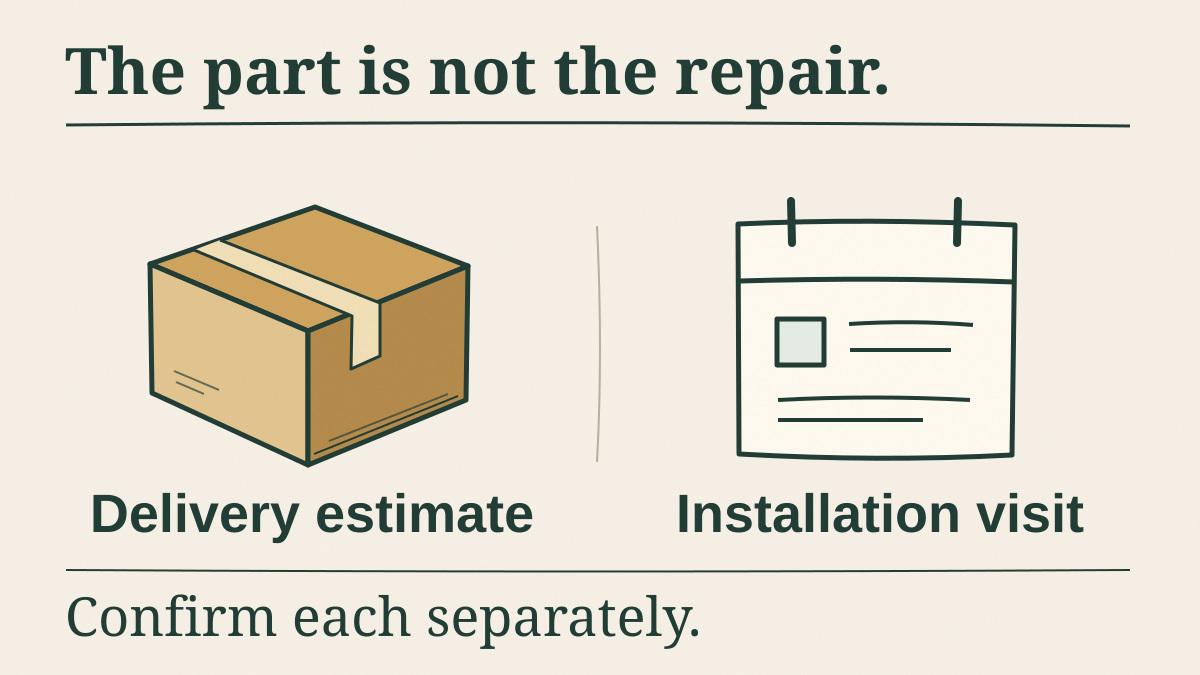
The contractor says the part is on order. The tenant asks when the appliance will work again. Your record says 'waiting on part,' but nobody has checked whether the supplier has stock or whether the installer has a return visit booked.
A parts delay needs a next action, not just a status. Keep the supplier's estimate separate from a confirmed installation appointment. Then record who will check the order, when the tenant will hear from you, and what happens if the estimate slips.
First decide whether waiting is an acceptable response
Reassess the current condition before discussing shipping. Loss of an essential service, active damage, or a safety concern may need a different response now. Arrange qualified help and emergency services where appropriate. Do not tell a tenant to keep using questionable equipment, bypass a safety device, or attempt a temporary repair.
Ask the qualified provider what can safely remain in service, what must stop, and what alternatives are appropriate. Confirm your obligations under the lease and current local requirements. A backorder is a supply problem; it does not by itself extend a repair deadline or settle whether a temporary alternative is adequate.
Write down the interim plan and its limits. If the situation changes, reassess it immediately rather than waiting for the next routine supplier check. This workflow tracks unfinished work. It does not determine habitability or authorize a delay.
Check the identity before chasing the shipment
Use the appliance's complete model number and the provider's diagnosis, not a photo of a similar-looking machine. GE Appliances explains that most repair parts are model specific and directs customers to model-number searches for compatible parts. Follow the actual manufacturer's process, and have the provider or supplier confirm compatibility, including any serial-number range or replacement part number that matters.
Keep a safe, readable photo of the equipment label with the appliance record. Do not ask someone to move heavy equipment, remove a cover, or reach into a hazardous area just to get it. If the label is inaccessible, let the qualified provider identify the unit.
Record the approved part number, supplier, order reference, quantity, order date, and who placed the order. If the contractor orders it, ask for a usable status reference rather than assuming you control the purchase. Record who is responsible for checking delivery and arranging installation. Keep payment details and tenant information out of a broadly shared tracking sheet.
Use separate fields for delivery and installation
Ask what 'ordered' means in this case. An order acknowledgment is different from stock allocated to the order. An estimated ship date is different from a carrier delivery estimate. Delivery is different from a checked, correct part in the installer's hands. None of those facts is a confirmed installation appointment.
Copy the estimate with its source and the time you checked it: 'Supplier estimates dispatch Thursday; checked Tuesday morning; installation not booked.' If the supplier gives no date, write 'date unknown.' Do not convert that into a promise because the tenant needs an answer.
Before offering a visit, confirm who will receive the part, who will check it for damage and correct identity, and whether the provider needs anything else to complete the work. Arrange lawful notice and access for the actual visit. A tentative slot can be useful, but label it tentative and explain what still has to happen.
Use this compact record: Property and equipment: __. Current service condition: __. Provider and approved part: __. Order reference and ordering contact: __. Supplier status, source, and checked time: __. Delivery estimate: __. Installation status: __. Interim plan: __. Next action, owner, and check time: __. Tenant's next update: __. Trigger for another decision: __.
Give the tenant a next update you can actually keep
In this fictional example, a qualified technician has assessed a dishwasher and advised that it remain off while a replacement component is obtained. The owner records that advice and checks the required response for the property. The supplier has acknowledged the order but has not confirmed dispatch. The owner does not describe Friday as a repair date.
A factual update could read: 'The technician has identified the replacement part and the order is acknowledged. We do not yet have a confirmed delivery or installation date. I will check with the contractor tomorrow morning and update you by noon, even if the supplier has not provided a date. Please continue following the technician's instructions and report any change in the condition promptly.' Use only statements that are true for your actual case.
The update commitment belongs to you even when the delivery estimate belongs to someone else. If there is no change, say what you checked and what you are doing next. Avoid repeated 'soon' messages that leave the tenant unable to tell whether anyone has followed up.
Tasks in LetsGoLandlord.com support a due date, optional due time, and notes, and can link to a property, lease, or open maintenance ticket. Use a task for the supplier callback and record the responsible person's name in the note. Completing that callback does not mean the repair is complete. The software does not order parts, verify compatibility, track a shipment automatically, or guarantee a repair date.
Decide what happens when the estimate slips
Choose a decision trigger when you first record the delay. It might be a missed dispatch estimate, a supplier unable to confirm stock, or a change in the tenant's circumstances or equipment condition. The right trigger depends on urgency and applicable duties; this is not a suggested number of days that every landlord may wait.
At that point, ask the provider about verified alternative supply, an appropriate substitute, another repair approach, or replacement of the equipment. Compare actual availability and the work needed to install it, not just the advertised price. Do not order a look-alike part or accept a substitution without appropriate compatibility and safety confirmation.
If you change the plan, identify who will cancel or return the earlier order and check the supplier's terms. Record any agreed charges and the remaining work. Keep that decision separate from paying an invoice. Once the needed response is arranged, the linked rental ROI calculator can help revisit maintenance-cost assumptions in your budget; it cannot decide whether a repair may wait.
Close the overall repair only after the required work and checks are complete, with the provider's findings and a tenant update recorded. A delivered box and a paid invoice are not evidence that the appliance works. Preserve any follow-up the provider recommends without hiding unfinished corrective work behind a closed ticket.
This article provides general operating information, not legal or repair advice. Repair duties, essential services, entry, temporary arrangements, and tenant remedies vary by location, lease, and circumstances. Check current applicable requirements and obtain qualified local advice. Equipment diagnosis, safe use, and part selection belong with qualified providers and the manufacturer's guidance.