A new tenant sends one payment labeled "move-in money." It appears to cover the deposit, first month's rent, a partial month, and a pet charge. The total looks right, but nobody can say which amount belongs to which charge or whether the bank transfer has actually cleared.
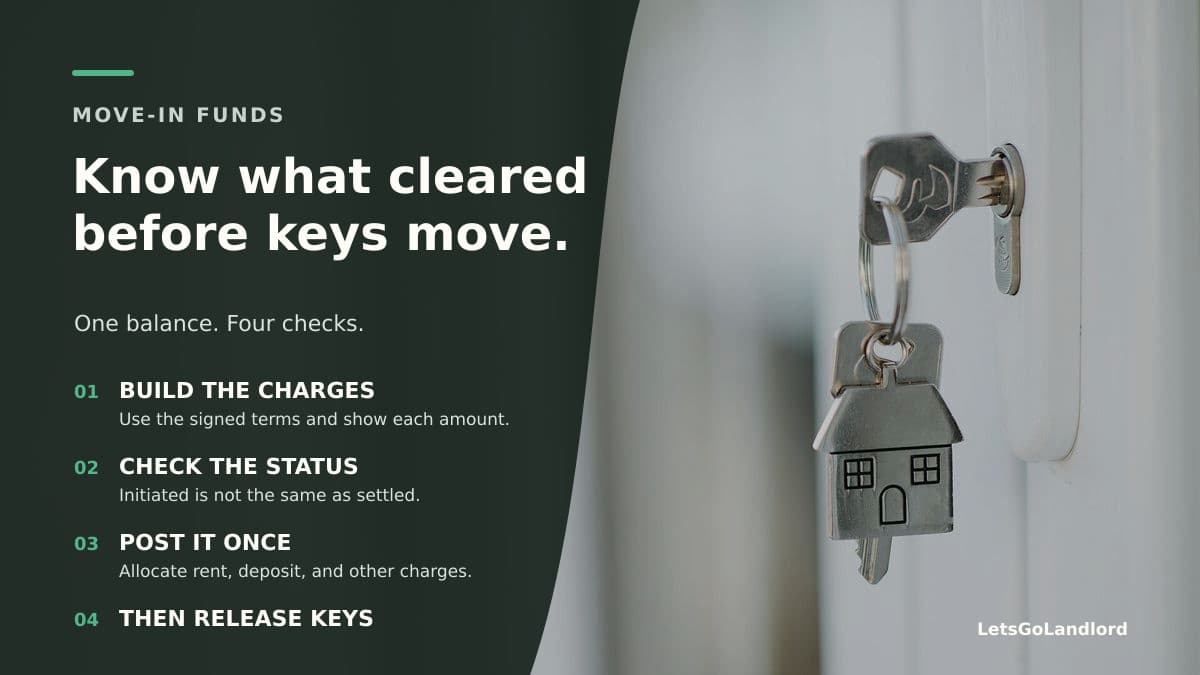
Use a move-in funds worksheet before accepting the first payment. It should show every amount due, when it is due, how it will be paid, the payment status, and where the money was posted. That record can keep an exciting handoff from turning into a balance dispute in the first week.
Build the balance from signed terms
Start with the signed lease and any addenda. List each charge on its own line: rent for the first full period, prorated rent if the tenancy begins mid-period, security deposit, and any other agreed move-in charge. Copy the name and amount from the documents rather than reconstructing the deal from text messages.
For a prorated amount, write down the full rent, start date, day-count method, and result. A visible calculation gives both sides something concrete to check. Confirm that the method matches the lease and any local requirement before collecting it.
Do not add an amount merely because it is common in another property or another state. Deposit limits, fee rules, required disclosures, payment-method rules, and timing differ by location. This article provides general operating information, not legal or financial advice. Check the signed documents and current local requirements, and use a qualified local professional when the treatment is unclear.
Give every charge its own destination
A correct total can still create a bad record. If $3,250 arrives, allocate it against the named charges instead of posting one generic receipt. The ledger should show how much went to rent, how much went to the deposit, and how much went to any other permitted charge. If the payment is short, record the remaining balance rather than quietly changing the original amounts.
Keep the deposit category distinct from rent and fees, including in the accounting or banking workflow you use. Local rules may control where deposit money is held, what notice is required, whether interest applies, and how the funds are described. A label in software does not satisfy those duties by itself.
Save the worksheet beside the signed documents. It should agree with the ledger, receipts, and actual bank activity. If one record says the deposit was $1,500 and another says $1,650, resolve the difference before the keys change hands.
Separate initiated, processing, settled, and failed
A screenshot showing that a tenant pressed Pay is not proof that the money arrived. Use plain payment states. Initiated means the tenant submitted it. Processing means the bank or card network is still moving it. Settled means the payment completed. Failed, returned, or disputed means the balance needs attention again.
Decide which status satisfies the move-in terms before the appointment. That decision should follow the lease, local requirements, and the payment method in use. Apply the same rule consistently. Do not improvise a different standard at the doorway because one tenant used a bank transfer and another brought a cashier's check.
In LetsGoLandlord, each online bank payment remains processing until it settles, and the ledger does not show it as paid while the transfer can still fail. Once a payment settles, it posts against the tenant's balance. If it later returns, the ledger reverses the payment and restores the amount owed. That status trail is more useful than a single paid checkbox.
Reconcile the payment before the handoff
Before the move-in appointment, compare four things: the worksheet, the payment processor or bank status, the property ledger, and the lease. Confirm that every charge has an amount, every payment has a status, and every settled amount has been allocated once. Watch for duplicate entries when somebody records a manual payment while an online payment is still moving.
Handle exceptions in writing. If the parties agree to a later due date, partial payment, corrected charge, or different payment method, document the agreed change in the proper place. Do not erase the original balance and leave no trail. The record should show what changed and why.
If the funds are not in the required status, pause and follow the documents and local rules. A calm delay is easier to explain than handing over possession under one understanding and trying to rewrite the deal afterward.
Issue a receipt that can be checked later
Give the tenant a receipt or payment confirmation in the form the lease and local rules require. At minimum, your internal copy should identify the tenant, property, date, amount, method, payment status, and allocation by charge. Avoid putting full bank account numbers, card details, or unrelated personal information on the working record.
A receipt should match the status it describes. If a bank transfer is still processing, do not call it settled. If cash is accepted, count it carefully, provide the required receipt promptly, and post it to the same ledger used for other payment methods.
Save the receipt with the move-in documents and give it a stable filename or reference number. Months later, both parties should be able to answer the same question: what was paid, what did it cover, and when did it become final?
Close the worksheet only after keys and records agree
The final check belongs immediately before key release. Confirm the identity and property, signed documents, required payment status, recorded allocations, receipt, utility or insurance evidence when the agreement requires it, and the number of keys or access devices issued. Keep payment and property-condition work separate. The move-in inspection records condition; the funds worksheet records money.
Mark the worksheet complete only when each line has an owner and a result. A missing payment should have a next action and date. An unsettled transfer should remain open. A corrected charge should point to the document that supports it.
After the handoff, compare the ledger with the first bank or processor settlement report. That last check catches a return, duplicate, fee deduction, or posting error while the move-in is still fresh. Then archive the worksheet with the lease and receipt instead of leaving it in a private inbox.