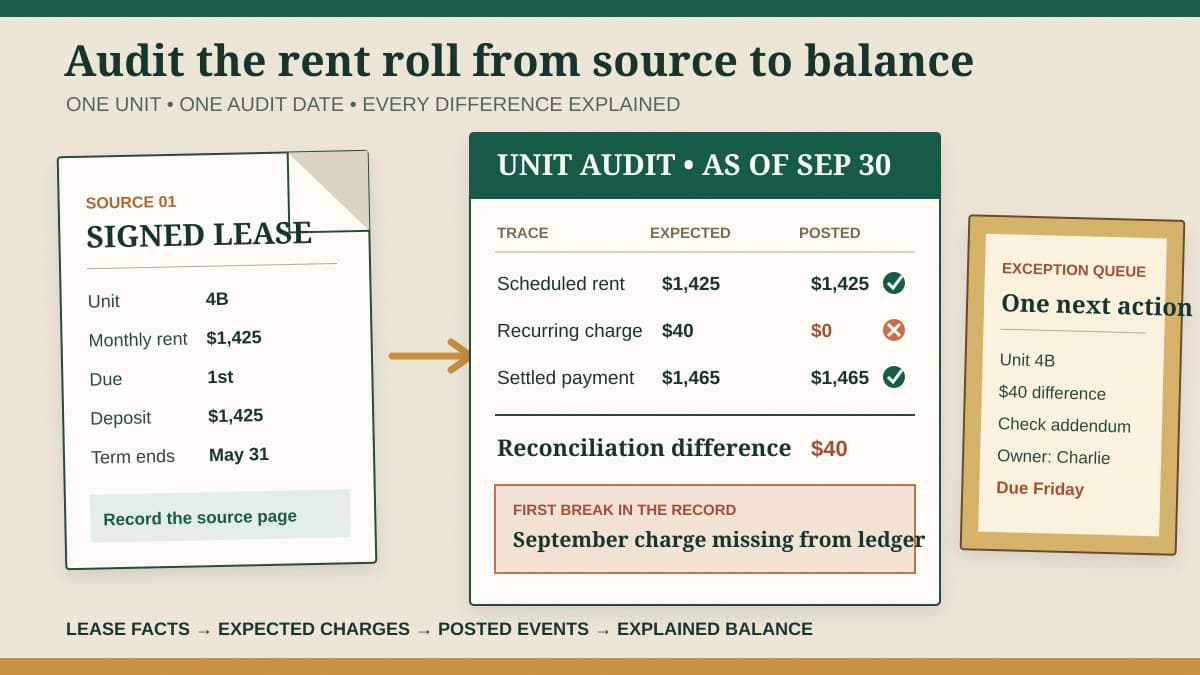
The rent roll says Unit 4 owes $75. The signed lease says rent increased three months ago. The bank shows a payment that never reached the tenant ledger. All three records may be individually readable, yet they do not describe the same account.
A rent roll audit finds those disagreements before they reach a renewal, owner report, collection decision, or year-end file. Work unit by unit. Start with the signed lease, rebuild what should have happened, compare it with what was posted, and put every unexplained difference in a visible exception queue.
Freeze the audit date and unit list
Choose an as-of date before comparing numbers. A balance at the end of September cannot be checked against payments through October 3. Save or export the rent roll for the chosen date, then list every unit as occupied, vacant, under notice, or otherwise requiring review. Do not let a missing unit disappear simply because it has no active row.
Use stable property and unit identifiers. Addresses are often abbreviated differently in a lease, bank memo, spreadsheet, and software account. Record one operating label and note any source wording needed to trace the documents. Check that each active tenancy appears once and that ended tenancies have a clear end date rather than remaining mixed with current accounts.
Name the person doing the audit and the date it began. If records change during the review, keep the original snapshot. Otherwise a correction made halfway through can make earlier totals impossible to reproduce.
Read the signed lease before trusting the row
For each occupied unit, open the signed lease and any signed amendment that changes the current terms. Verify the tenant names, unit, lease start and end dates, scheduled rent, due date, deposit amount, recurring charges, credits, concessions, and any effective date for a change. Record the source page for every figure that may need another look.
Do not treat a draft, unsigned renewal, email summary, or prior lease as the current source merely because it is easier to find. When several documents conflict, label the conflict and stop short of deciding which one controls. The audit should expose the source problem, not settle a legal question by editing the rent roll.
Use the lease language as written. A monthly amount does not by itself explain how a partial first month, subsidy, recurring fee, or midterm change should appear. Separate the fact you can read from the conclusion that may require a current agreement, local rule, or professional review.
Rebuild the expected charge schedule
Create a short expected schedule from the lease facts. For each period, list the rent and each separate recurring charge, the effective date, and any supported credit or concession. Then compare that schedule with the charges actually posted to the tenant ledger.
Check timing as well as totals. Two ledgers can reach the same balance even when one charge was posted in the wrong month and another was omitted. That timing error may matter when you review a payment, notice, late charge, owner statement, or lease renewal.
Keep one-time items separate from recurring terms. A repair reimbursement, returned-payment charge, utility billback, manual credit, or deposit adjustment needs its own source and approval trail. Do not fold it into monthly rent to make the row easier to scan.
Trace every payment to evidence
Compare ledger receipts with settled bank deposits or processor records for the same period. Check amount, date, payer clue, transaction reference, tenant account, and allocation. A matching amount helps narrow the search, but it does not prove that the payment belongs to that unit.
Keep pending, returned, reversed, and refunded payments in their real state. A payment that appeared briefly in the bank feed should not remain credited after a return. Likewise, a settled deposit should not sit outside the ledger merely because the payer used a different name or combined several obligations.
For split or partial payments, prove that every allocation adds back to the source transaction. Preserve the original payment date and reference on each applied part. If the intended allocation is uncertain, leave the money in review instead of using it to make the oldest balance look cleaner.
Recalculate the balance from events
Do not confirm a balance by comparing it with last month's balance. Recalculate from a known starting point using charges, payments, credits, reversals, and adjustments through the audit date. The ending amount should match the rent roll and the tenant ledger.
When the numbers disagree, find the first event where the running balances separate. That is usually faster than staring at the ending difference. Record the missing, duplicated, misdated, or misapplied entry and link it to the source that supports the correction.
Review zero and credit balances too. A zero can hide equal and opposite errors. A credit may be valid, may belong to another charge, or may come from a duplicate payment. The audit is complete only when the event history explains the result.
Keep corrections in an exception queue
Give each disagreement one line with the property and unit, observed difference, source records checked, amount if known, next action, owner, and due date. Use a small set of states such as needs document, needs payment match, needs ledger correction, needs professional review, and resolved.
Do not change the lease fact, charge, and payment at the same time without recording what was wrong. Correct the specific event supported by the evidence, preserve the earlier audit snapshot, and note who approved the change. If the correction affects a tenant communication, owner report, filing, or legal process, review that downstream work separately.
Close an exception only after the source, ledger, and rent roll agree. Then rerun the property total. Unit-level corrections can change scheduled rent, collected rent, delinquency, deposits held, and occupancy figures used elsewhere.
Use software to expose the work, not hide it
LetsGoLandlord can build a rent roll from uploaded lease PDFs, showing extracted tenants, dates, rent, deposits, and lease status for your review. You review every extracted field before it becomes part of the rent roll. Use the source document and ledger detail to resolve exceptions rather than accepting a populated row because it looks complete.
Keep the audit cadence tied to real risk. Review after a lease import, renewal, rent change, returned payment, ownership report, or system migration. A monthly pass can catch routine posting mistakes, while a full source-to-ledger review may be better before year-end or a major handoff.
This article provides general operating information, not legal, tax, or accounting advice. Lease interpretation, payment application, fees, notices, deposits, subsidies, record retention, and corrections depend on the facts and current requirements. Use qualified local professionals when a discrepancy affects a tenant's rights, a filing, or a formal financial record.
Finish with a repeatable tie-out
At closeout, count the units in the source list and the audited rent roll. Total scheduled rent, posted charges, settled payments, open balances, credits, and unresolved exceptions. Keep the snapshot, exception log, completion date, and reviewer together so the next audit can start from a known point.
Test one unit in reverse. Start with the ending balance and trace it through the ledger, payment evidence, expected schedule, and signed lease. If that path breaks, the record still depends on memory or an unsupported cell. Repair the link before calling the rent roll reviewed.