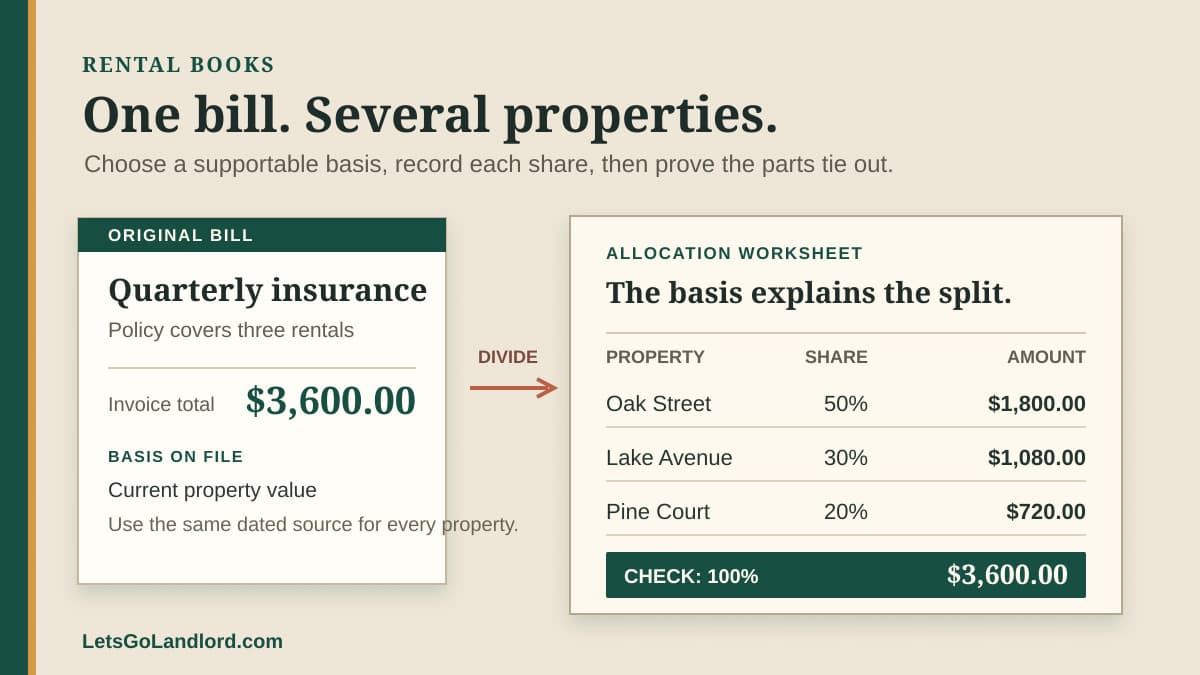
One insurance invoice covers three rentals. The payment leaves the bank once, but each property needs its own expense. Copying the full charge to every property triples the cost. Leaving it on one property makes that building look less profitable while the others look better than they are.
Treat the invoice as the source record and the property amounts as allocations from it. A clean split answers four questions: what was paid, which properties benefited, why each property received its share, and whether the parts add back to the original bill to the cent.
Keep the source bill intact
Start with the vendor, invoice number, service or coverage period, payment date, total amount, and the document that supports the charge. Record the bank transaction or payment reference separately. One proves what the vendor billed. The other proves how and when it was paid.
Do not edit the invoice total into a property amount. Preserve the original $3,600 charge even if the first property receives only $1,800. The allocation record should point to that source and show every part created from it.
Check whether the bill really belongs across properties. A vendor may send several property-specific jobs on one invoice, or one policy may include charges that apply to different buildings. Use line-level amounts when the source already identifies them instead of replacing better evidence with a broad formula.
Choose a basis you can explain
The allocation basis should match the cost and the information available. An even split may fit one flat service performed once at each property. Loan balance may fit a shared blanket-loan cost. Property value may fit a portfolio charge calculated from insured or assessed values. Custom amounts may fit an invoice whose line items already show the work at each address.
Write the basis beside the split. 'Thirty percent to Lake Avenue' is only an answer. A note that ties the percentage to Lake Avenue's share of the three properties' current values, all from the September 2026 review, shows where the answer came from.
Use values from the same source and date when the calculation compares properties. Mixing one current value with two old estimates produces precise-looking percentages that do not share a consistent basis. If a required figure is missing, resolve the gap or document a temporary method rather than silently treating the missing property as zero.
Calculate in cents, then handle the remainder
Convert the total to cents before dividing it. Percentage calculations often produce fractions of a cent, so round the property amounts with a rule that still returns the exact invoice total. When one cent remains, assign it consistently, such as to the property with the largest fractional remainder.
For a $3,600 bill allocated 50%, 30%, and 20%, the amounts are $1,800, $1,080, and $720. Their sum is $3,600. For a total that does not divide cleanly, keep the invoice total fixed and adjust the rounded parts. Never change the source charge just to make an even division easier.
Check both dollars and scope. The amounts can sum correctly while a property is missing, listed twice, or included for the wrong period. Confirm the selected properties before accepting the arithmetic.
Create one linked property record per share
Each property record needs the allocated amount, expense date, vendor, category, memo, allocation basis, and a link or reference to the source bill. Keep the original invoice number on every share so a later review can gather the pieces without searching by amount alone.
Use the same expense category only when the shares represent the same kind of cost. If one invoice combines repairs, supplies, and another charge, separate the supported lines before allocating them. The act of splitting a payment does not decide its bookkeeping or tax treatment.
Give the split a shared identifier or note, such as 'September policy renewal, three-property allocation.' That connection matters when somebody opens one property's ledger months later and needs to understand why the amount differs from the invoice total.
Check the split from both directions
First, start with the invoice and add the property shares. The result must equal the bill. Then start with each property and trace its amount back to the invoice, basis, and other shares. Both paths should work without relying on an unexplained spreadsheet cell.
Compare the source payment with the bank record once it posts. A split allocates one cost across properties; it should not create several bank payments. Reconciliation should connect the one cash movement to the grouped property records rather than trying to match each share to a separate withdrawal.
If the vendor later issues a credit, refund, or corrected invoice, record the new event and allocate it using a documented basis. Do not overwrite the original shares in a way that erases what was paid and reported at the time.
Use software without giving up the reasoning
LetsGoLandlord can split one bill among selected properties by an even split, loan balance, property value, or custom amounts. It creates one expense per property, checks the submitted parts against the bill total, and keeps the split records grouped. Review the selected properties, source figures, category, and basis before saving.
The software can protect the arithmetic and preserve the connections. It cannot decide which allocation method fits a contract, filing position, ownership arrangement, or professional workpaper. Keep the source and the reason close enough that another person can review the choice.
This article provides general recordkeeping information, not tax or accounting advice. Allocation methods, capitalization, deductions, ownership reporting, and supporting records depend on the facts and current requirements. Use a qualified tax or accounting professional when the split affects a return, financial statement, partner allocation, or disputed charge.
Run the tie-out before month end
Review every grouped split with the same short test: one source bill is attached, all affected properties are present once, the basis is named and supported, each share is recorded, and the shares equal the source total. Resolve differences while the invoice and calculation are still easy to retrieve.
A shared expense is complete when you can move from the bill to every property entry and back again. If one amount has no basis or one property entry has no source, the split still needs work, even when the total happens to match.