A security deposit itemized statement reconciles money held with deductions you can explain and support. It connects the deposit record, documented conditions, costs, and balance to return. It should not be assembled from memory after the contractor finishes or the tenant asks where the refund went.
Build it so someone who never walked through the rental can follow each line back to its evidence. The workflow below is an operating method, not a nationwide legal form. Check the property's jurisdiction at the start, including any notice or inspection obligations that arise before move-out. Review the final packet against those requirements before service.
The statement is a reconciliation, not a repair list
Keep the turnover work order and the deposit statement separate. A work order tells a vendor what to repair, clean, or replace. The statement explains what money you propose to retain and why. Repainting a room for the next tenancy may belong on the work order without belonging on the tenant's statement.
Start with the deposit ledger. Confirm the amount actually received, any documented transfers or earlier returns, and the amount still held for this tenancy. Do not use the deposit figure in the lease without reconciling it to the receipt history. Flag disputed entries rather than quietly adjusting the opening balance.
Identify the tenancy, rental unit, statement date, and period being reconciled. Track any interest or other required credit separately so it does not vanish inside the deduction total. Interest treatment is jurisdiction-specific: the New York Attorney General's residential tenants' rights guide, linked below, describes rules that depend on the building and account circumstances. That is a reason to check the applicable rule, not to apply New York's treatment nationwide.
Build the evidence file before deciding deductions
Gather the lease and amendments, deposit ledger, move-in and move-out condition records, inspection photos, relevant repair history, tenant communications, and cost documents. For an unpaid-rent item under consideration, gather the charge and payment history too. A photo cannot establish an account balance.
Assign each source a readable reference using its room, item, and record date. Pair a context view with the detail that matters. Preserve the record of when the observation was made and distinguish it from a file's upload date. Keep original camera files separately from edited or processed copies; an upload timestamp does not establish when a photo was taken.
LetsGoLandlord.com can show move-in and move-out inspection items and photos side by side, giving a statement a condition record to point to instead of a recollection. You still select the relevant evidence and assemble the statement's supporting packet yourself.
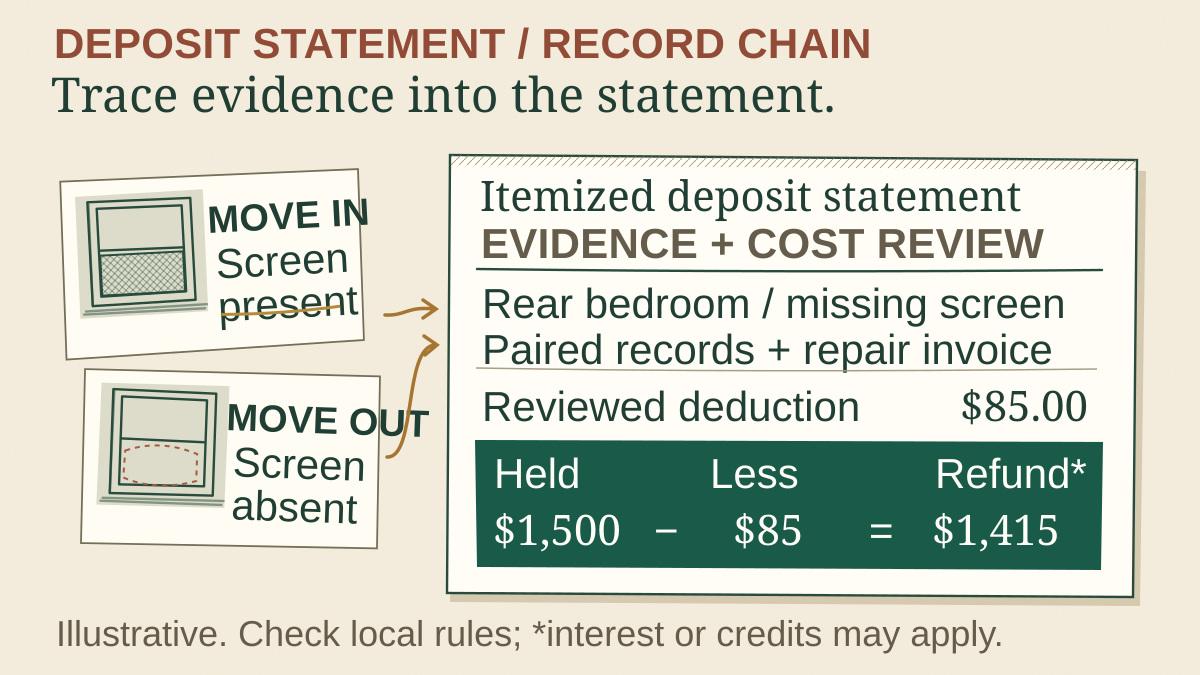
Where the record is incomplete, write down the gap. If a move-in photograph does not show the window screen, do not describe it as proof that the screen was present. Find another reliable record or leave the proposed deduction unresolved for review.
Separate an observed change from a chargeable deduction
An observation and a decision belong in different fields. 'Screen absent at move-out' describes a condition. 'Charge the tenant for a replacement screen' adds conclusions about responsibility, allowable deductions, and amount. Make those decisions explicitly instead of letting a condition label become a charge.
For each proposed deduction, check the starting condition, ordinary use during the tenancy, reported defects, maintenance history, and any explanation from the tenant. Consider normal wear and tear, pre-existing damage, age, and remaining useful life before proposing replacement cost. Do not invent a universal depreciation schedule or assume a new replacement price is the deductible amount.
The California Courts guide linked below distinguishes damage beyond normal wear and tear from other turnover work and describes limits on cleaning deductions. Those are California-specific rules, not permission to charge the same categories elsewhere. Use your property's current law to decide which costs, if any, belong on the statement.
Record the cost of the work and the proposed deductible portion separately. Explain any allocation or reduction. Check for duplicate charges where one invoice covers several tasks or a tenant has already reimbursed a cost. A supported invoice establishes what was billed; it does not, by itself, establish what the tenant owes.
Write one deduction line another person can retrace
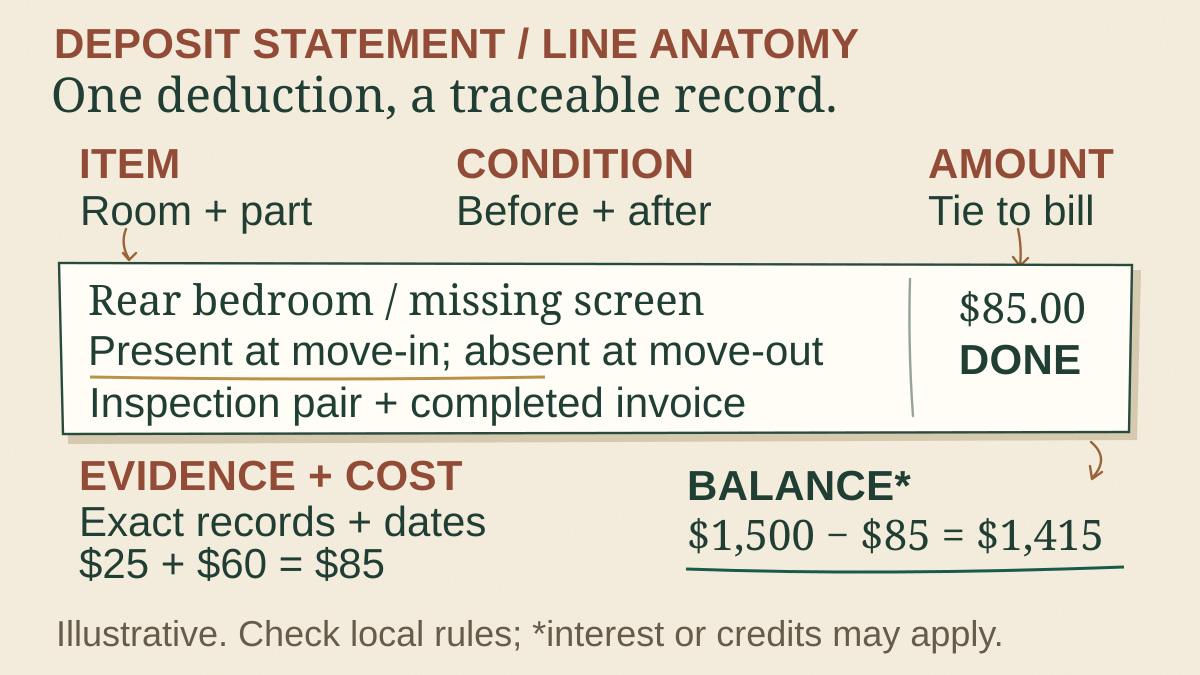
Use these fields in your working record: description; location or item; observed condition; evidence reference; amount; source of amount; completed or estimated status. If your statement form has only a description and an amount, put the identifying detail and source reference into the description, then supply the supporting schedule as the applicable rules require.
Illustrative line, subject to a local allowability review: 'Replace missing window screen; rear bedroom; recorded present at move-in and absent at move-out; see paired inspection records and screen detail photos; $85.00; completed repair invoice, $25.00 materials plus $60.00 labor; completed.' These are invented teaching amounts, not a recommended charge or evidence from a real tenancy. In an actual statement, replace the general references with the exact records and dates from that file.
Avoid entries such as 'damages, $500' or 'repairs per invoice.' Name the item and work, then identify the part of the source bill that supports the amount. For your own labor, maintain a task, time, and rate record for review; do not assume that any chosen hourly rate or owner labor charge is allowable.
Mark completed work and estimated work accurately. Never present a quote as a paid invoice. The California Courts guide describes a conditional estimate and later-receipt process when repairs cannot be finished in time. That process is specific to California; check whether your jurisdiction permits an estimate, under what conditions, and what follow-up is required. A pending invoice is not a reason to assume the deadline pauses.
Make the math tie out
For the deposit reconciliation, deposit held minus total deductions equals balance to return. Use the amount applied against the deposit in that calculation, and show any separately required interest or credits in the final refund calculation. Add the deduction lines independently rather than trusting a copied subtotal.
Arithmetic-only example: $1,500.00 held minus one $85.00 deduction equals $1,415.00 to return, before any separately required interest or credits. The $85.00 line ties back to $25.00 in materials plus $60.00 in labor. This example assumes the deduction has passed the local review; the math does not decide whether it is allowable.
Keep claims beyond the deposit separate. A negative subtraction result is not a negative refund or proof of an enforceable debt. Show how much of the deposit is applied, the resulting deposit balance, and any excess proposed claim separately for legal review. Do not turn that excess into a demand simply because a spreadsheet calculated it.
The notice workflow in LetsGoLandlord.com uses description-and-amount deduction rows and calculates the total claim and remaining deposit balance. Its state-rule data can also surface deposit-disposition deadline reminders after move-out. You must review the inputs and each deduction, verify the applicable rule, and check the final document; this is not a compliance guarantee.
Treat the deadline and delivery method as separate work
Open a timing and delivery checklist when move-out is planned, not after the deduction amounts are settled. Verify what event starts each applicable clock, which documents and payments are due, and whether dispatch or receipt matters. Use the state deadline and statute tool below to locate a starting reference, then read the current statute and any applicable local requirements.
Check the delivery method, recipient, address, prescribed language, required enclosures, and any signature or follow-up requirements separately from the calculation. Do not assume that emailing a PDF, uploading it to a portal, or using certified mail satisfies every jurisdiction. Record the verified requirement and the source you checked beside the task.
The California Courts guide and the New York Attorney General's guide describe different deposit-return procedures, and the New York guide distinguishes non-regulated from rent-regulated units. Neither is a national rule. USAGov's state tenant-rights resource, also linked below, directs readers to state agencies and legal help for housing disputes.
Give the tenant a usable statement and retain the final packet
Read the packet as its recipient. Can you find the deposit held, understand every deduction, locate its support, and reproduce the amount to return? Use plain descriptions and legible copies. Match each attachment label to the reference in the statement. Include what the applicable rules require rather than relying on a link that could expire.
Keep an exact copy of the final packet, including the statement, supporting documents sent, refund record, and delivery evidence. Preserve the underlying evidence file too. Record the version and service date without overwriting earlier drafts or changing the copy already sent. Limit access to people who need the tenancy records.
Set the retention period using applicable law, professional advice, and any dispute-preservation obligations. This guide does not prescribe a nationwide retention period. If a dispute or correction arises, preserve the relevant records and obtain local advice before altering the packet or issuing a revised notice.
Run the final state-specific check before service
First, verify the governing state and local requirements for this property and tenancy, including any special housing program rules. Confirm the deadline trigger, allowable deductions, treatment of interest, required wording and documentation, delivery method, and any estimate follow-up. Escalate missing evidence or uncertainty while there is still time to act.
Then audit one deduction backward: amount to cost source, description to condition record, condition record to the starting condition. Recalculate the totals and confirm the planned refund agrees with the statement. For a larger portfolio, use the same review fields for every unit but keep jurisdiction-specific decisions attached to each tenancy. One landlord can perform a separate second pass; a team can assign another reviewer.
This is general operating information, not legal advice. Security-deposit rules, deadlines, allowable deductions, notices, and delivery requirements depend on the property’s jurisdiction and facts. Verify current requirements with the applicable statute and a qualified local professional.