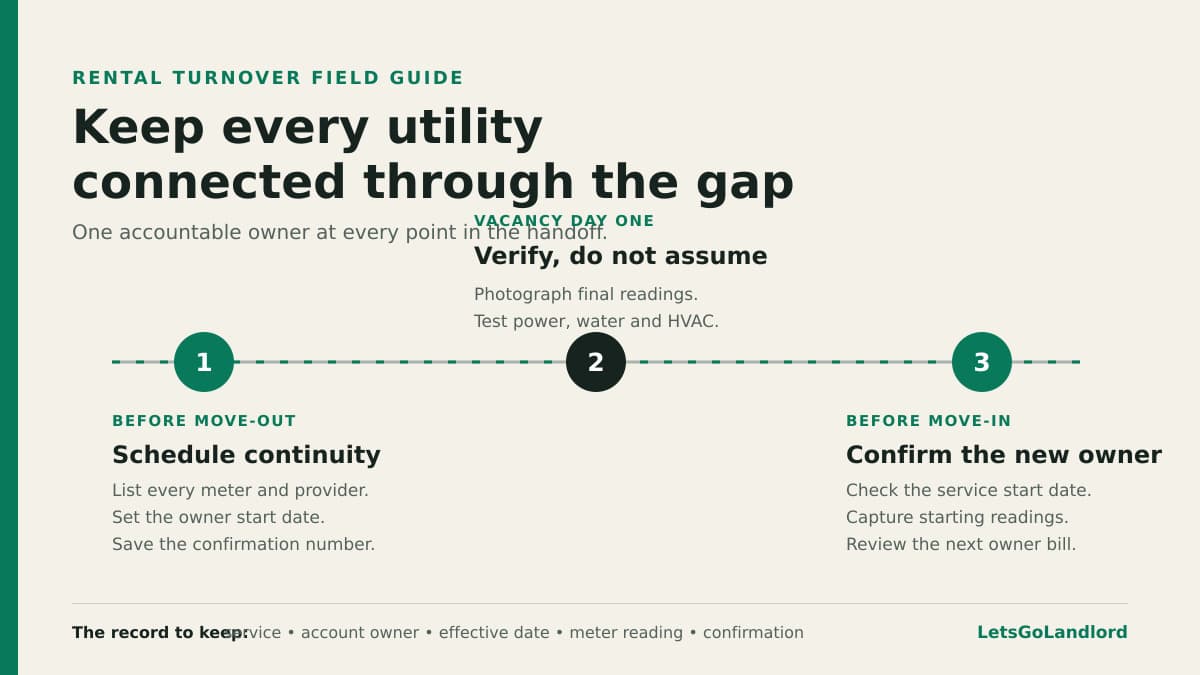
A tenant moves out on Friday. The electric account closes that night, the cleaner arrives Monday, and the refrigerator sits without power all weekend. Nobody intended to shut the unit down. The service simply had no named owner for the gap.
Utility handoffs are small jobs with expensive failure modes. Frozen pipes, spoiled food, a missed leak, an alarm without power, or a cleaner who cannot work can turn a routine turnover into an avoidable repair. Use one list for every service and work from confirmed dates rather than assumptions.
Build a utility inventory before anyone gives notice
List every service tied to the property: electricity, water, sewer, gas, trash, internet, shared-area service, irrigation, propane, and any utility billed through an association. Record the provider, account contact number, meter location, normal billing arrangement, and whose name should appear on the account during occupancy and vacancy.
Separate whole-property accounts from unit accounts. A duplex may have tenant-paid electric meters but one owner-paid water account. A small apartment building may have hallway lights on a house meter. If everything lives in one row called 'utilities,' the account most likely to be missed is the one that serves no individual unit.
Keep account numbers and login credentials in an approved private system, not in a turnover checklist that gets shared with vendors or tenants. The working checklist usually needs only the provider, service address, meter label, responsibility, dates, and confirmation status.
Set the vacancy handoff before move-out
Contact each provider early enough to learn its transfer process. Ask whether service can revert automatically to an owner account when a tenant closes theirs. If the provider offers an owner continuity or landlord agreement, confirm which meters it covers and the exact start condition. Do not assume one agreement covers a second building or a newly added meter.
For services without automatic reversion, schedule the owner account to begin when the tenant's responsibility ends. Avoid relying on a verbal promise that the tenant will leave service active. The account holder controls the cancellation, and their plans may change.
Write down the effective date and confirmation number. Put a separate verification task on the calendar for the first day of the vacancy. A scheduled transfer is a request. A working light, running water, and an active account are confirmation.
Capture final readings and test the empty unit
At move-out, photograph each meter straight on so the reading and meter identifier are legible in the same frame. Note the date and time. If a provider uses a remote reading, the photo still gives you a record for the handoff date. Keep the images with the inspection rather than in a personal camera roll.
Once the unit is empty, test what the turnover crew will need. Switch on lights, run water at each fixture, confirm hot water where applicable, check the thermostat, and verify that the refrigerator and any sump or lift pump have power. Look for leaks after the water has run. The goal is not a full property inspection. It is to catch a failed handoff before the first contractor discovers it.
Set the vacant unit for protection, not comfort. Choose heating, cooling, and water settings that fit the property, weather, equipment, insurer requirements, and local conditions. If you are unsure how to winterize or protect a specific system, use a qualified local professional.
Give the incoming tenant a clean start
Tell the new tenant which services they must place in their name, the provider names, service address format, and required start date. Send this early enough to solve identity checks, deposits, or appointment delays. Do not send the prior tenant's bill or account details as an example.
Ask for confirmation that required accounts are scheduled, but do not collect more personal information than you need. The cleanest proof is usually a provider confirmation that shows the service address and start date while hiding the tenant's account number. If local rules or the lease treat utility setup differently, follow those requirements.
On move-in day, capture starting meter readings and test service again. Keep the owner's account active until the new service is confirmed where the provider permits overlap. Close the turnover task only after every service has a current owner and the house or vacancy account is no longer being billed by mistake.
Reconcile the first bill after the handoff
The final check happens after move-in. Review the next owner bill for service dates, meter identifiers, final readings, activation fees, and overlap. A bill that spans the vacancy and the new tenancy may be correct, but you should be able to explain each date before recording it.
In LetsGoLandlord, an owner-paid utility can be recorded as a property expense. If the lease and applicable rules make a tenant responsible for a reimbursable amount, a utility charge can be added to that lease's ledger. Keep the provider bill and your calculation with the record so the amount does not appear without an explanation.
For a mid-month move-in, the prorated rent calculator handles the rent math separately from utilities. The turnover record should preserve the facts: who held each account, when responsibility changed, what the meters showed, and what the provider billed.