A technician finds more damage than the tenant reported. The original estimate says "repair leak," but the vendor now wants to replace the shutoff valve, open the cabinet wall, and add a second visit. The landlord approves the extra work by phone. When the invoice arrives, nobody agrees on what the approval covered.
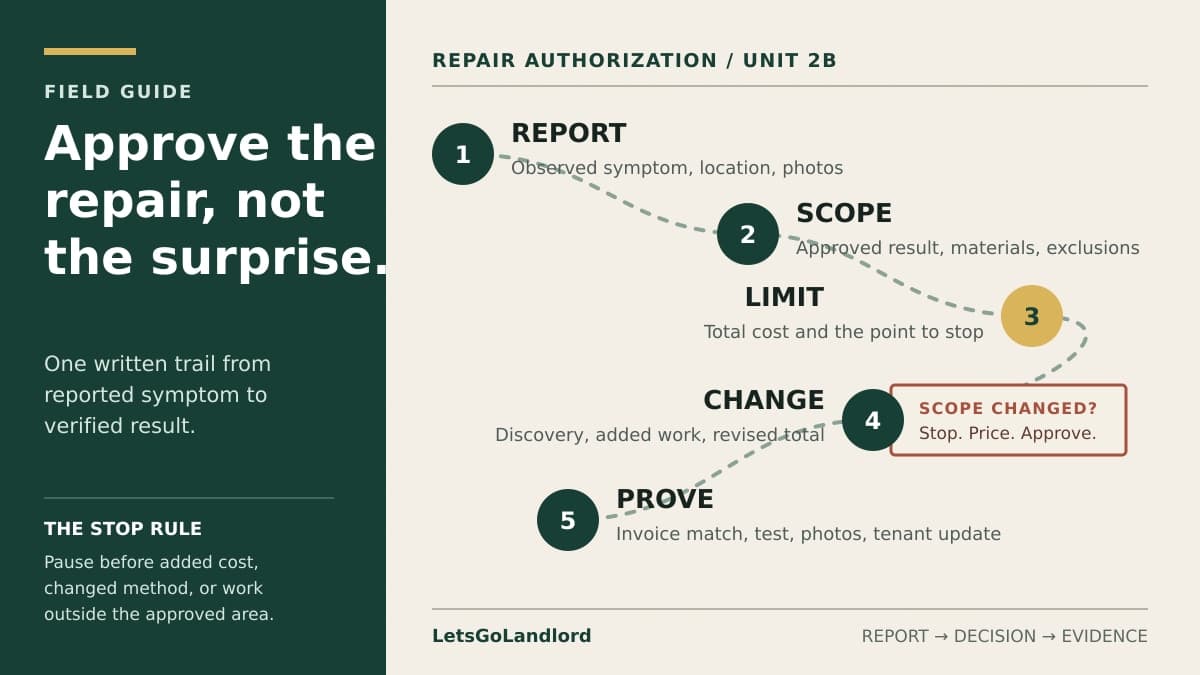
A useful repair approval is more than permission to start. It identifies the reported problem, describes the result you are buying, sets a spending boundary, names the person who can approve a change, and states what evidence will close the job. Put those details in writing before the vendor begins whenever the situation allows.
Separate the reported problem from the diagnosis
Start with what has been observed. Record the tenant's words, the location, when the problem began, what makes it better or worse, and any photographs or video. "Water appears under the kitchen sink when the faucet runs" is an observation. "The drain assembly has failed" is a diagnosis that still needs confirmation.
Ask the vendor to confirm the cause before treating the first guess as the approved scope. A short diagnostic visit may be the cleanest first authorization when the cause is uncertain. State whether diagnosis alone is approved or whether the vendor may complete a defined repair during the same visit up to a set limit.
Urgent conditions need a faster response, but speed should not erase the record. Note who reported the condition, what immediate step was authorized, why waiting for a normal estimate was not practical, and who received the update. Keep emergency safety decisions with qualified people.
Approve a result, not a vague activity
Write the approved scope so another person can tell when the job is finished. Name the location, work to be performed, materials or quality level when they matter, access assumptions, cleanup, and the test that should prove the repair. "Replace the leaking kitchen faucet supply line and run both taps for five minutes with no visible leak" is clearer than "fix sink."
List exclusions when the boundary could be misunderstood. If the approval does not include cabinet replacement, mold assessment, repainting, after-hours work, or work in another room, say so. An exclusion does not mean the issue can be ignored. It means the vendor must stop and return with new information before crossing that boundary.
Keep legal duties and the vendor's work order in their proper places. The work order documents what you authorized. It does not determine habitability, required response time, licensing, permitting, tenant notice, or who ultimately bears a cost. This article provides general operating information, not legal advice. Check the lease and current state and local requirements, and use qualified local help where needed.
Set an authorization limit with a stop rule
A dollar ceiling is useful only when everyone knows what it includes. State whether the authorization limit covers labor, materials, service charges, tax, disposal, parking, and return visits. If the vendor quotes a range, decide whether the upper end is authorized or whether the range is information for a separate decision.
Add a stop rule. The vendor should pause before exceeding the limit, changing the approved method, opening a wall or other concealed area, substituting a materially different item, or discovering work outside the agreed location. Name the person who can approve a change and the channel that counts as approval.
Do not use a standing spending limit as blanket permission for every repair. A trusted vendor may have authority to prevent active damage or restore a basic service up to a fixed amount, while cosmetic changes and replacements still require a separate approval. Write down those categories instead of relying on a shared memory of the arrangement.
Make change orders small and specific
When the scope changes, ask for a short change request before the new work starts. It should show what was discovered, why the approved approach no longer works, the added or removed work, the price and schedule effect, and any consequence of stopping. A photo or brief video can make the decision faster without replacing the vendor's explanation.
Reply with a clear approval, rejection, or request for another option. Avoid messages such as "do what you need to do" unless you genuinely intend to authorize an open-ended result. Repeat the revised total and scope in the approval so the decision does not depend on reconstructing a long text thread later.
If immediate action is needed to prevent injury or further property damage, document the verbal approval as soon as practical. Record the time, participants, condition, work authorized, revised limit, and next update. The goal is not paperwork for its own sake. It is a usable account of a decision made under pressure.
Match the invoice to the decision trail
Before paying, compare the invoice with the original approval and every accepted change. Check the service address, unit, work dates, labor, materials, added charges, credits, and total. Ask about differences while the technician's notes and photographs are still available.
Require the completion proof named in the approval. Depending on the job, that may include arrival and departure times, before and after photographs, model or part information, a test result, permit or inspection evidence, warranty details, and an open-item note. Keep personal belongings and unrelated parts of the tenant's home out of the photos.
A paid invoice does not prove the original symptom is gone. Confirm the result safely, update the tenant, and leave the ticket open if a return visit or monitoring period remains. Record who verified the result and when. If the repair cannot be tested immediately, schedule the condition that will test it.
Keep one record from report to closeout
The final file should connect the original report, diagnosis, approved scope, estimate, authorization limit, change requests, approvals, vendor evidence, invoice, tenant updates, and verification. Store access codes and other reusable secrets somewhere controlled, not in the repair history.
LetsGoLandlord keeps photos, timestamps, status changes, and updates in one maintenance ticket timeline. Add the approved scope and spending boundary before work starts, record each accepted change as an update, and attach the closeout evidence to the same ticket. The software preserves the trail. It does not decide whether a repair is required, whether a price is reasonable, or whether a vendor is qualified.
Review the approval when a job runs over budget or needs an avoidable return visit. The weak point may be the diagnosis, scope, stop rule, access plan, or completion test. Fix the field that failed before copying the approval format to the next repair.