Most rental inspection photo sets are nearly useless. There are 80 pictures, but half are blurry, nobody can tell which bedroom is shown, and the one damaged cabinet appears only in the corner of a wide shot. Good documentation is not about taking more photos. It is about taking the same useful photos every time.
The method below works for move-in, move-out, annual, and maintenance inspections. It also makes side-by-side comparison possible months or years later.
Use a seven-photo sequence in every room
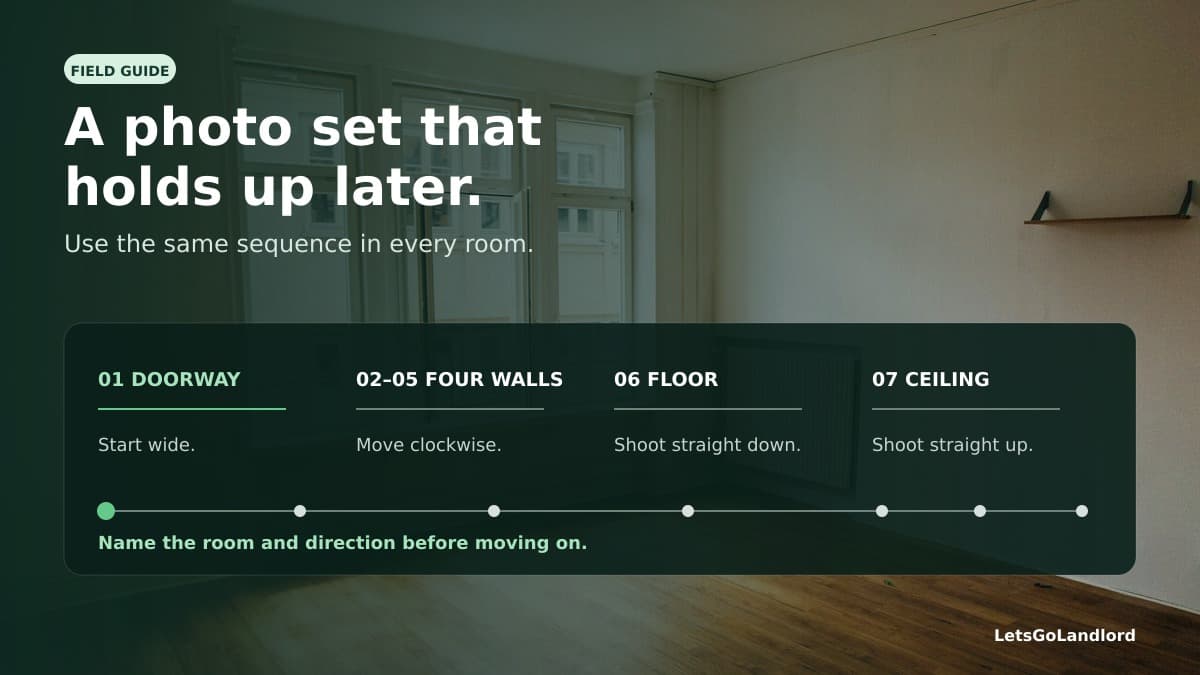
Start at the doorway and take one wide photo. Move clockwise and photograph each wall straight on. Finish with the floor and ceiling. Use the room name in your notes before moving on. 'Rear bedroom, east wall' will still mean something two years from now. 'IMG_4827' will not.
Keep the camera around chest height for the wall photos. Stand in roughly the same doorway and use the same direction during the next inspection. Consistency matters more than getting a dramatic real-estate-listing angle.
Add detail shots that answer four questions
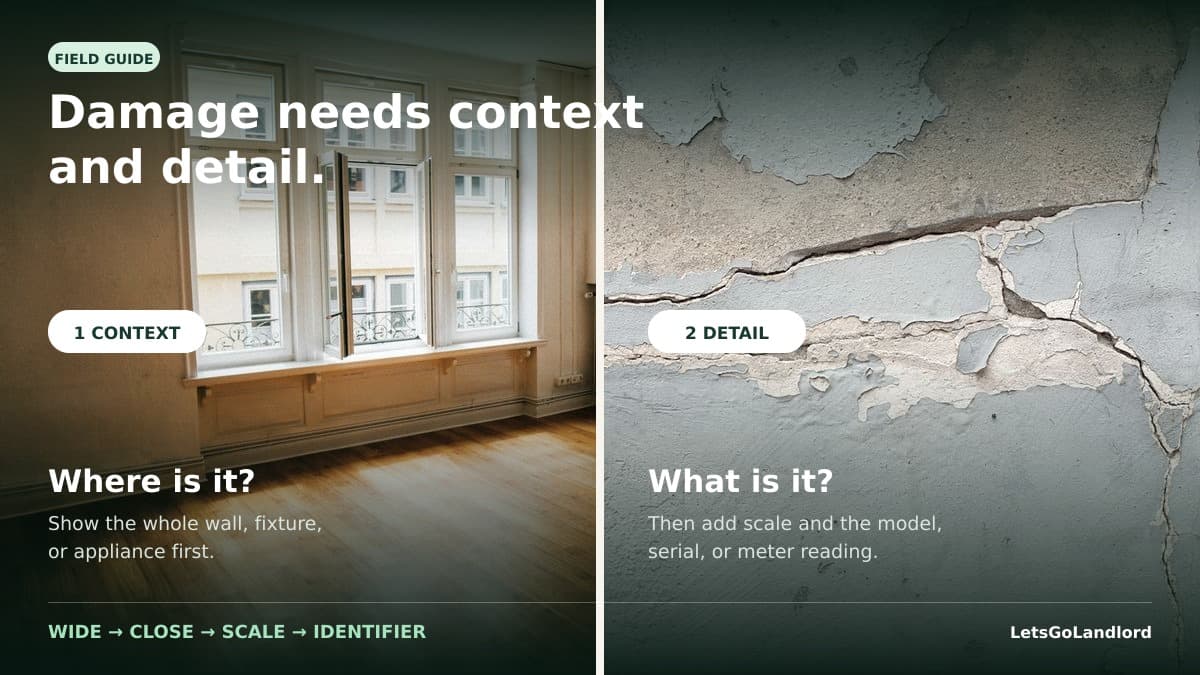
For any defect, take a context photo, a close photo, a size reference, and the identifying detail. The context photo proves location. The close photo shows the condition. A ruler, coin, or common object shows scale. The identifying detail might be an appliance model and serial number, a meter reading, or the label on a smoke alarm.
This pattern is especially useful for cracked tile, countertop burns, stained carpet, appliance damage, water marks, missing hardware, and holes that are larger than ordinary nail holes. Photograph inside sinks and cabinets too. Slow leaks often show there before they reach the room below.
Photograph function, not just appearance
A clean-looking smoke alarm photo does not prove it worked. Take a short video or note the test result. Run each faucet long enough to check the drain and the cabinet below. Show that windows open, lock, and have intact screens. Record the HVAC filter size and condition. Capture appliance displays while they are operating.
At move-in, photograph every key, remote, parking pass, and garage opener being handed over. At move-out, photograph meter readings and the exact set returned. These small records settle surprisingly expensive arguments.
Do not edit the originals
Keep the original files with their capture metadata in your own archive. If you crop or mark up a copy, retain the untouched original beside it. Store the photos under the property, inspection date, room, and item. A folder called 'Unit 2 move-out' is better than a camera roll, but a room-by-room inspection timeline is better still.
LetsGoLandlord files uploaded inspection copies by room, records when each upload was added, and compares move-in with move-out side by side. It strips embedded photo metadata during processing, so keep your original camera files separately if you may need their capture metadata. A maintenance issue found during the inspection can become a tracked ticket instead of disappearing into a note.
The ten-minute final pass
Before leaving, count rooms against your checklist. Confirm you captured the exterior, address, utility meters, safety devices, appliance labels, keys, and any defect that needs repair. Open a few photos at full size while you are still on site. A blurred serial number is cheap to retake now and annoying to discover later.
If you manage several units, use one inspection template for all of them. LetsGoLandlord includes room-by-room checklists and reminder schedules, so the process stays the same even when the property, tenant, or person doing the inspection changes. The useful part is not the checklist itself. It is having comparable evidence the next time you walk through the door.