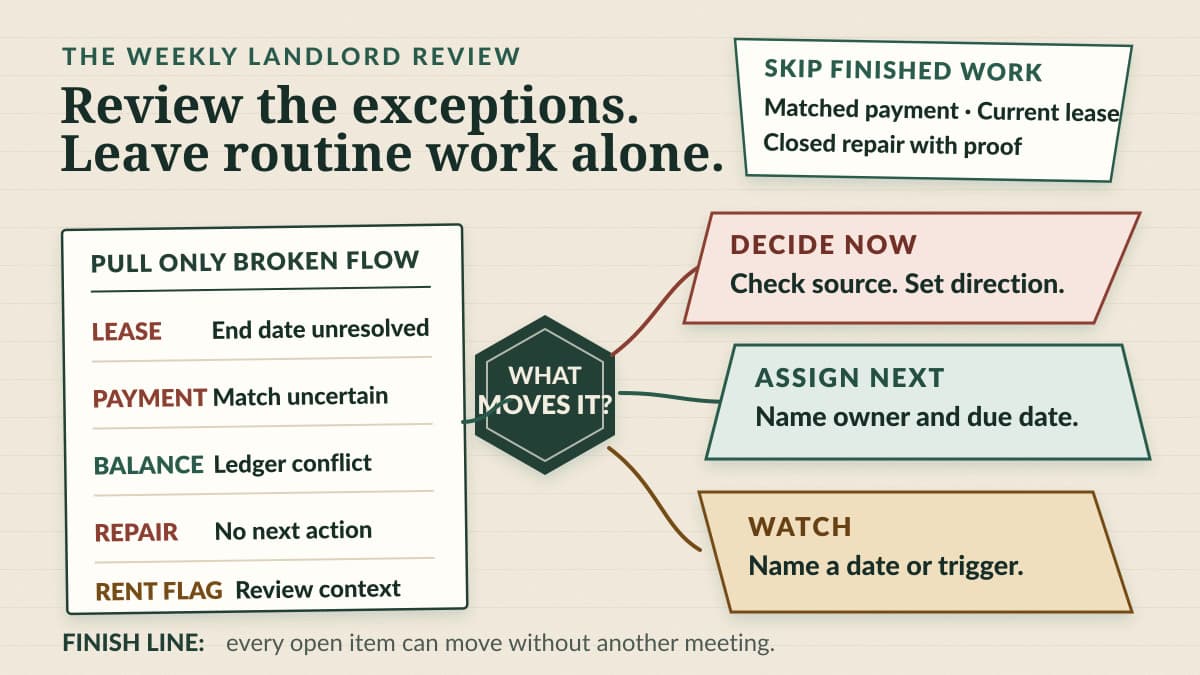
Monday starts with a lease expiring soon, two deposits you cannot identify, a repair waiting on a vendor, and a tenant balance that looks wrong. None of those items belongs on the same checklist. One needs a decision, one needs research, one needs a follow-up, and one may only need a corrected record.
A weekly exception review keeps those loose ends from becoming a second inbox. You are not reviewing every lease, payment, and ticket. You are looking for records that broke the normal flow, deciding what needs attention this week, and giving each open item a specific next action or watch condition.
Set a fixed review window
Choose one time each week when the books are reasonably current and the people who may need assignments are reachable. Thirty quiet minutes on Monday morning can work for a small portfolio. A larger operation may need separate payment and maintenance passes, followed by one short decision meeting. The schedule matters less than making the review predictable.
Use one working list. Do not assemble a fresh list from texts, email flags, paper notes, and memory each week. Start from the systems that hold leases, balances, payments, maintenance records, and tasks. Add an item only when it needs a decision, an assignment, or a defined watch condition.
Keep routine completed work out of the meeting. A correctly matched rent payment does not need discussion. A closed repair with the invoice and completion note attached does not need to be admired again. Exceptions deserve the time because the normal process did not finish on its own.
Look ahead at leases before they become urgent
Review leases approaching their end date and leases that have already expired in the record. Confirm the signed source, end date, renewal or holdover language, current rent, deposit record, and any open conversation. An approaching date is a prompt to review. It is not permission to assume what the tenant wants or what action local rules allow.
Separate the landlord decision from the tenant communication. The first action may be checking the signed lease, reviewing current property plans, or asking a local professional about a notice requirement. Once the decision and required process are clear, give the actual communication an owner and date.
Flag data conflicts instead of fixing them from memory. If the lease PDF says one date and the rent roll says another, link both sources and assign a source check. A tidy but unsupported date can be more dangerous than an openly unresolved one.
Review money that did not land cleanly
Pull the positive tenant balances and unreviewed payments. For each balance, ask whether the ledger has all expected charges, credits, and confirmed payments. For each incoming payment, ask whether the payer, property, lease, amount, and posting date support a match. Leave uncertain deposits in review rather than attaching them to the nearest familiar name.
A balance is a starting point, not a complete explanation. A partial payment, returned payment, duplicate charge, unapplied credit, posting delay, or lease change can produce a number that needs context. Open the underlying entries before choosing a collection or correction action.
Give reconciliation work a finish line. 'Check payment' is not enough. Write 'compare the September 8 deposit with Unit 4's ledger and bank reference by Tuesday.' If another person must provide a receipt or identify a payer, name that person and the next follow-up date.
Find maintenance tickets that stopped moving
Review open maintenance tickets by current condition and last meaningful update. The age of a ticket matters, but silence can matter more. A two-day-old active leak with no confirmed response deserves attention before a ten-day-old cosmetic item that is waiting on an agreed delivery date.
Ask what the ticket is waiting for. Common answers include tenant details, safe access, a vendor appointment, a diagnosis, approval, a part, completion proof, or a tenant closeout. Turn that dependency into the next action. 'Waiting on plumber' becomes 'Morgan will confirm arrival window with plumber by 3 p.m. Monday and update the tenant.'
Do not mark a ticket complete because the vendor left or an invoice arrived. Keep it open until the result has been checked against the reported condition, the tenant has the needed update, and any follow-up has its own date. If the repair can only be verified after rain, another equipment cycle, or a return visit, record that trigger.
Sort every exception into one of three paths
Use three paths instead of one long priority pile. Decide now is for work that cannot move until the landlord chooses a direction, such as approving a defined repair or deciding whether to begin a lease review. Assign next is for work with a known action that somebody can own. Watch is for an item that should stay open until a named date or condition occurs.
A watch item must have a trigger. 'Keep an eye on ceiling stain' will disappear. 'Inspect the marked ceiling area after the next heavy rain, or on September 28 if no rain occurs' tells you when the item returns. Watching is a controlled state, not a polite way to avoid a decision.
If an item does not fit any path, the record may still be too vague. Return to the source and state what is known, what is missing, and which missing fact would change the next step. Then assign the smallest action that can get that fact.
Write the next action so it survives handoff
Every action should name the record, the result needed, one owner, and a due date or trigger. Include the stop point when authority is limited. 'Call electrician' leaves too much to interpretation. 'Ask the licensed electrician to inspect the Unit 2 bedroom outlet, provide the cause and proposed scope, and stop before repair unless separately approved' is ready to hand off.
Keep the next action with the lease, payment, ticket, property, or task that created it. A private notebook may feel faster, but nobody else can see whether the item moved. A general team chat is searchable until the same property appears in six unrelated conversations.
Close the old action when a new one begins. If the vendor sends an estimate, the 'obtain estimate' task is complete. The repair still needs a separate approve, decline, or revise decision. This keeps an open job from looking overdue merely because its first step still carries the original date.
Let the digest find the queue, then verify the record
LetsGoLandlord sends a weekly digest that can surface renewal-due leases, expired leases, positive balances owed, unreviewed payments, open maintenance tickets, and units flagged below the configured market threshold when Rent Radar monitoring is enabled. It also places the digest in the notification feed. Use it to open the review, then check each underlying record before making a decision. The digest points to exceptions. It does not supply legal judgment, diagnose repairs, or prove that a ledger entry is correct.
Keep market review separate from an automatic rent decision. A unit flagged below a market estimate still needs a direct look at the property, lease, current comparables, condition, local requirements, and the effect on the tenancy. If no action is warranted, record the review date and reason rather than repeatedly debating the same alert.
This article provides general operating information, not legal, tax, accounting, or safety advice. Lease decisions, notices, fees, collections, repairs, entry, privacy, and record retention depend on the facts and current requirements where the property is located. Use qualified local professionals for decisions and work outside your competence.
End with a short exception log
Finish by recording what changed during the review. Keep the item, source record, path, next action, owner, due date or trigger, and last update. The log should be short because the detailed evidence stays in the underlying record. Its job is to show what remains open and where to find it.
Carry forward only items that still have a valid next step or watch condition. Rewrite vague carryovers before ending the session. If the same exception returns for several weeks, inspect the process that creates it. Repeated unmatched deposits may need a clearer payer reference. Repeated vendor silence may need a confirmation rule or another vendor.
The review is done when each exception can move without another meeting. Some will be resolved that morning. Others will wait for a document, appointment, weather event, or tenant reply. They can stay open without getting lost because the next owner and return point are already written down.