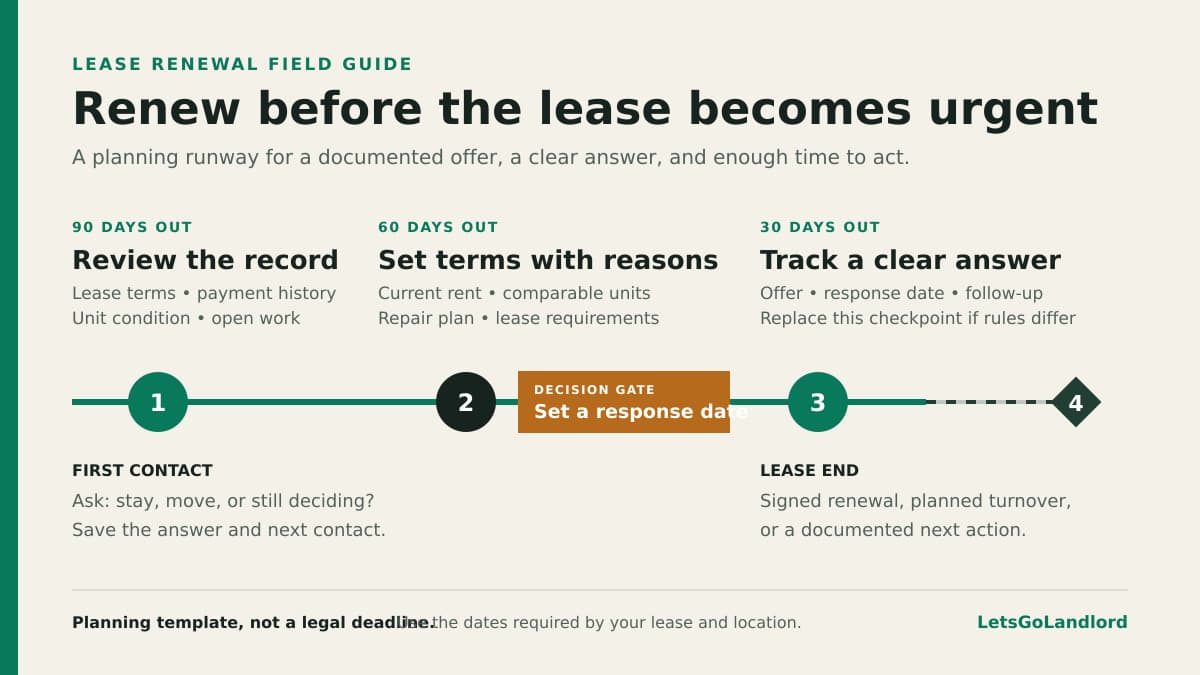
A lease can feel comfortably far from its end date until a tenant says they are moving and the calendar suddenly looks tight. Now you need a decision on rent, a turnover plan, and time to market the unit. The first renewal conversation should happen while all of those choices are still manageable.
Starting early does not mean pressuring a tenant for an immediate answer. It means asking a simple question, setting a date to talk again, and doing your own homework before you make an offer.
Open with a check-in, not a renewal packet
The first message can be short: "Your lease ends on [date]. Are you hoping to stay, planning to move, or still figuring it out?" You do not need to lead with a rent number or attach a new lease before you know what the tenant wants.
Each answer is useful. A tenant who plans to stay gives you a reason to prepare terms. A tenant who plans to leave gives you more time for turnover. Someone who is unsure gives you a follow-up date. Record the answer and the next contact, rather than trusting yourself to remember a casual text three weeks later.
Keep the tone factual. A renewal is a business decision for both sides. The tenant may be considering a job change, a home purchase, a different school route, or a move closer to family. You need a planning answer, not a defense of their choice.
Build the timeline from the actual lease
Read the signed lease and every later amendment before choosing dates. Confirm the lease end, renewal language, notice provisions, current rent, recurring charges, and any responsibilities that changed during the term. A date copied into a spreadsheet is not enough if the parties later signed an extension.
A 90, 60, and 30-day runway can work as an internal planning template. At 90 days, review the record and ask about intent. At 60 days, settle on the terms you are prepared to offer. At 30 days, you should be tracking a clear answer or following the next step required by your documents and local rules. These checkpoints are not universal legal deadlines.
Renewal, non-renewal, notice, and rent-change requirements depend on the lease and location. This article is general operational information, not legal advice. Verify the rules that apply to the property before sending a formal notice or changing tenancy terms. If anything is unclear, use a qualified local professional.
Prepare your side before naming a number
Pull together the current rent, payment record, unresolved maintenance, unit condition, tenant requests, deposit record, and any work you expect during the next term. This is also a good time to correct open paperwork instead of carrying a fuzzy agreement into another year.
Check comparable rentals, but do not pretend that asking rents make the decision for you. A nearby listing cannot price the cost of your likely turnover, the condition of this unit, or the value of a tenant who communicates and pays reliably. Use market evidence as one input and write down why your proposed terms make sense.
Decide what you can offer before the conversation becomes a negotiation. That may be another fixed term, a different term length, a change in rent, or no renewal offer. If you have several acceptable options, rank them. Thinking this through in advance is much easier than inventing terms while a tenant waits on the phone.
Make the offer easy to answer
Put the practical terms in plain language: proposed start and end dates, monthly rent, changes to recurring charges or responsibilities, the response date, and what happens next. The formal document still matters, but the tenant should be able to understand the offer in one read.
Give the response date a reason. You may need time to prepare a renewal document, schedule turnover work, or begin marketing if the tenant declines. An unexplained hard deadline can feel arbitrary. A clear planning date keeps the exchange direct without making it adversarial.
If the tenant asks for different terms, do not negotiate from a parking lot. Confirm what they are requesting and tell them when you will respond. Then compare the request with the options you already prepared. A measured answer is more useful than a quick one you need to reverse tomorrow.
Give every answer a next action
A yes should lead to the renewal document and a signing date. A no should open the turnover plan. A maybe should create a dated follow-up. No response should also have a next contact date. The dangerous status is not simply "no." It is "I think we handled that."
Save the offer, delivery date, tenant response, agreed changes, and signed document with the lease record. If the tenant plans to leave, confirm the expected move-out date and explain the next practical steps. Stay professional. Clear notice makes planning easier even when the vacancy is inconvenient.
After the decision, check the rest of the calendar. Several leases ending in one month can create more turnover than a small operation can handle comfortably. Staggering future term dates, where the parties agree and local requirements allow it, can make the next renewal season less crowded.
Keep a small renewal board
For every lease ending in the next few months, track six facts: lease end, tenant's stated plan, last contact, terms under review, response date, and next action. One row per lease is enough. The board should tell you what needs attention without forcing you to reread an email thread.
LetsGoLandlord reads lease dates and terms from uploaded documents, then places expiring leases in a renewal queue 90 days before the lease ends. Renewal Autopilot can notify you or prepare a draft using your settings and plain-language changes. Its optional auto mode can send qualifying renewals with no open balance after safety checks. The free AI lease audit is a quick way to review one document before you build the rest of the process.
Software can surface the date and prepare a draft. You still decide whether to renew, what to offer, whether local review is needed, and how to handle the conversation. That split is useful: the repetitive work stays visible, while the judgment stays with the landlord.