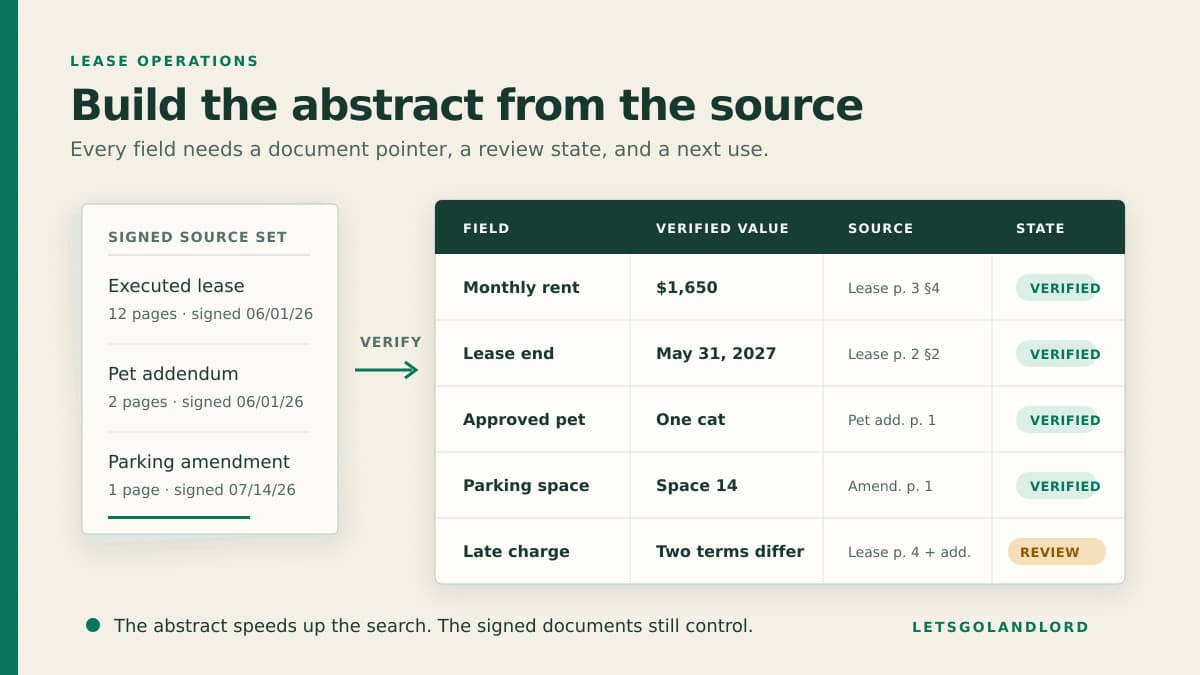
A signed lease may answer a simple question in three different places. The rent is on page two, the due date is in a payment clause, and an addendum changes the late charge. When the tenant calls, searching the whole file is slow. Trusting a number copied months ago can be worse.
A lease abstract is a short operating record of the facts you use repeatedly. It does not replace the lease. It points back to the signed lease, addenda, and amendments so you can check the source before acting.
Start with the complete signed file
Collect the executed lease, every signed addendum, later amendment, renewal, notice that changed a term, and any attached rules incorporated into the agreement. Put the documents in effective-date order. A clean unsigned template is not a substitute for the version the parties signed.
Confirm that the file is complete before extracting anything. Check the property and unit, tenant names, landlord or management party, signature pages, page count, and references to attachments. If page seven says "see pet addendum" and no pet addendum is present, record the missing document as an open item.
Keep the original files unchanged. Give each document a stable name such as "2026-06-01 signed lease" or "2026-07-14 parking addendum." The abstract should identify which file set it summarizes and when somebody last checked it.
Choose fields that support real work
Begin with identity and term facts: property, unit, parties, lease start, lease end, possession date, and renewal or holdover language. Then record the recurring financial terms you need to operate the tenancy, including base rent, due date, grace language, permitted late charge, recurring fees, security deposit stated in the agreement, and any utility responsibility assigned to either party.
Add operational terms that affect routine decisions. Examples include payment method language, maintenance reporting instructions, entry or notice clauses, parking, pets, smoking, insurance requirements, yard or snow duties, appliance responsibility, and the address or method for formal notices. Use fields that answer questions you actually receive. Do not turn the abstract into another full copy of the lease.
Separate a stated fact from your own workflow. "Rent due on the first" is a document fact. "Review unpaid balance on the third" is an internal action. Keeping those columns apart prevents an office habit from being mistaken for a lease term.
Attach a source page to every important fact
Every field should include a source document and source page, section, or paragraph. A rent entry might read "$1,650 monthly | lease p. 3, section 4." A pet entry might read "one cat approved | pet addendum p. 1." The pointer makes review fast and discourages confident guessing.
Quote short wording when the exact language matters. Dates and dollar amounts can usually be copied as values, but a renewal window, notice method, maintenance duty, or fee condition may lose meaning when reduced to a label. Keep enough of the original phrase to show the condition, then use the source pointer to reach the complete clause.
If the document is scanned and has no printed page numbers, use the PDF page number and note that convention. If a photo set has one image per page, give the images sequential names. The goal is simple: another person should be able to reach the supporting text without repeating your entire search.
Do not resolve conflicts by instinct
Addenda and amendments often control over older language, but do not decide that from memory. When two documents conflict, copy both terms, identify both sources, and flag the field for review. Record the later conclusion only after you have a sound basis for it.
Use explicit states for uncertainty: verified, missing, unreadable, conflicting, or needs local review. A blank cell can mean too many things. "Unreadable deposit amount, lease p. 4" tells the next person what to inspect. "Not found" should mean the reviewer looked and could not locate the term in the available file set.
Lease interpretation and landlord duties depend on the documents and applicable law. This article provides general operating information, not legal advice. Do not use an abstract to make a legal conclusion, send a formal notice, charge a fee, enter a unit, withhold money, or change a tenancy term without checking the signed documents and current requirements. Use a qualified local professional when the meaning or required action is uncertain.
Review the abstract against the ledger and calendar
Compare the lease abstract with the records that already drive daily work. Does the ledger use the same monthly rent and deposit amount? Does the renewal calendar use the signed end date and notice language? Do tenant and unit names match? List differences as corrections to investigate rather than quietly changing whichever record seems older.
Turn verified facts into dated actions only after the source check. A lease end can create a review date. An insurance requirement can create an expiry check. A utility duty can create a move-in or move-out task. Keep the action linked to the abstract field so anyone can see why it exists.
Do not copy sensitive information just because the lease contains it. The working abstract rarely needs bank details, identity-document numbers, full dates of birth, or unrelated personal history. Limit access to the signed files and abstract, and follow the retention and privacy rules that apply to your operation.
Use software as a first pass, then verify
For a small portfolio, a spreadsheet can work if each row has the value, source, review status, and next action. Keep one current record per lease and preserve earlier versions when a signed amendment changes a term. Do not let separate copies in email, cloud storage, and a local drive drift into competing versions.
LetsGoLandlord can read uploaded lease files and draft the property, unit, tenant, rent, deposit, term dates, and late-fee fields it finds. You review every extracted field before it becomes part of the rent roll. Unclear values are flagged for review instead of being silently treated as final.
Whether the first pass comes from software or a person, the control is the same. Match important facts to the signed source, leave uncertainty visible, and update the abstract when a later signed document changes the tenancy. A useful abstract saves search time without asking anyone to trust a summary blindly.